
Hill work for horses can offer major health benefits. Read on for techniques to help strengthen, condition or recondition and improve both you and your horse’s balance up and down hills.
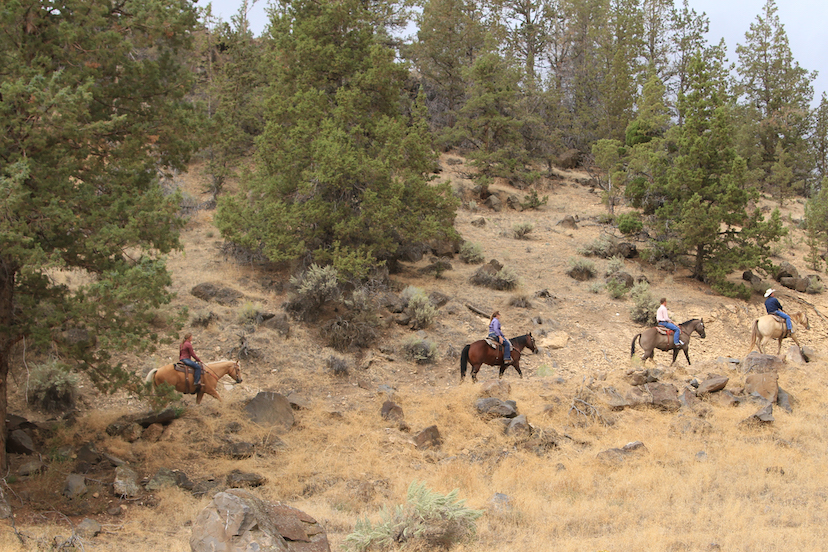 Trail ride up a hill (Credit: AQHA/Tara Matsler)
The presence of hills in a horse’s life can offer major health benefits. Horses raised on hilly pastures tend to have stronger hindquarters, more athleticism, better balance on varying terrain and a good sense of where their feet are.
Groundwork on hills can be beneficial for all horses. Young horses taken on “trail walks” can find confidence and balance without the added stress of balancing a rider (or, even worse, an unbalanced rider.) An unconfident horse of any age can also enjoy trail walks as a way to be exposed to varying terrain and obstacles while the handler stays safely at the end of the lead rope.
Riding on Hills
Once you are mounted up and ready to ride hills, you want to be absolutely sure you maintain your position over the center of your horse while traveling up or downhill. If you lean forward heading uphill, you are putting weight over your horse’s front legs – the very legs he is trying to pick up and use! If you lean back while traveling downhill, you are now loading your horse’s hindquarters. He needs to get his hind end underneath himself to negotiate the hill with balance. This allows him to pick his way down slowly and carefully.
Think of maintaining a position that is parallel to the trees.
Use your core abdominal muscles for balance, not your reins. Your horse needs his head for balance and has to be able to lower it to watch where he is putting his feet.
Try this: If you have a friend who will allow you to sit on his or her back, play with a change in your balance and ask the friend to pick up his or her arms as you move. See how your balance affects the ability to lift those appendages, then switch places.
Hills for Rehabilitation
Using hill-work for out-of-shape horses is a great way to rebuild muscle, strength and overall balance.
Using a gradually sloped hill and a 22-foot lead rope and rope halter: Circle, or longe, your horse from the ground without any other tack.
Start at the walk to slowly get your horse in shape, if needed, and to improve your skills before moving into a trot. Start with just five minutes each direction the first day, with a two-minute break in between the change of direction. You can move around as your horse circles. Don’t worry about standing in one spot, so long as your horse continues to circle up and down the grade.
( Do not use this method with an injured horse or a horse that requires veterinary care. This should be used to help a horse whose level of physical fitness is “going downhill” (no pun intended).)
Build up slowly each day and watch your horse begin to carry himself with more balance and strength. Use feel and judgment to determine what is right for your horse. Think about your horse’s condition and strength and work within his abilities. Continue hill therapy for at least one week. Ideally, you would continue this program, working on it for three days in Week 2 and two days a week during weeks 4-6. This should give your horse time to “reha-HILL-itate.”
If you don’t have hills where you live, you can use: Poles, Logs, Small barrels laid down on their sides, Cavalettis
Position these substitute “hills” on a very large circle, so your horse has to step over at least two of them on the circle at 3 and 9 o’clock. He will learn to lift his body to negotiate the poles.
During months of consistent work, you should see:
Advanced Hill Exercises
Below are some additional techniques that will help strengthen, condition or recondition and improve both you and your horse’s balance. But there are disadvantages of hill work for horses if you do it wrong. Before you get started, make sure you have your horse warmed up. With any exercise, horse or human, you can injure muscles if you dive right into it. Also, be aware that hill exercises are very strenuous. As you are building your horse’s muscles, be sure that you are not breaking his wind, stamina or trust in you.
We have found it is better to change up the routine and work different muscles every day. You can do so much and make your training work to fit your schedule so it is fun and not a chore.